Sal Stewart’s 98th RBI didn’t just pad his stat line. It sharpened the central question in the National League Rookie of the Year race: should voters reward the rookie with the loudest power numbers, or the one delivering the most complete performance across offense, baserunning, and defense?
No rookie has built a more traditional case than Stewart. The Reds infielder leads NL rookies with 27 home runs, seven more than any other rookie. No one else in the league’s rookie class has even reached 20. His 98 RBIs lead all of Major League Baseball, a staggering total for a 22-year-old on one of the majors’ weakest offensive teams.
Stewart’s numbers demand attention. He was one of two NL rookies selected to the All-Star team this summer. The other, Foster Griffin, was traded by the Nationals to the Guardians and now plays in the American League. That leaves Stewart as the lone NL rookie All-Star still in the thick of the award race, a contest with the pressure of an upper-bracket final.
Stewart’s power case goes beyond the RBI column
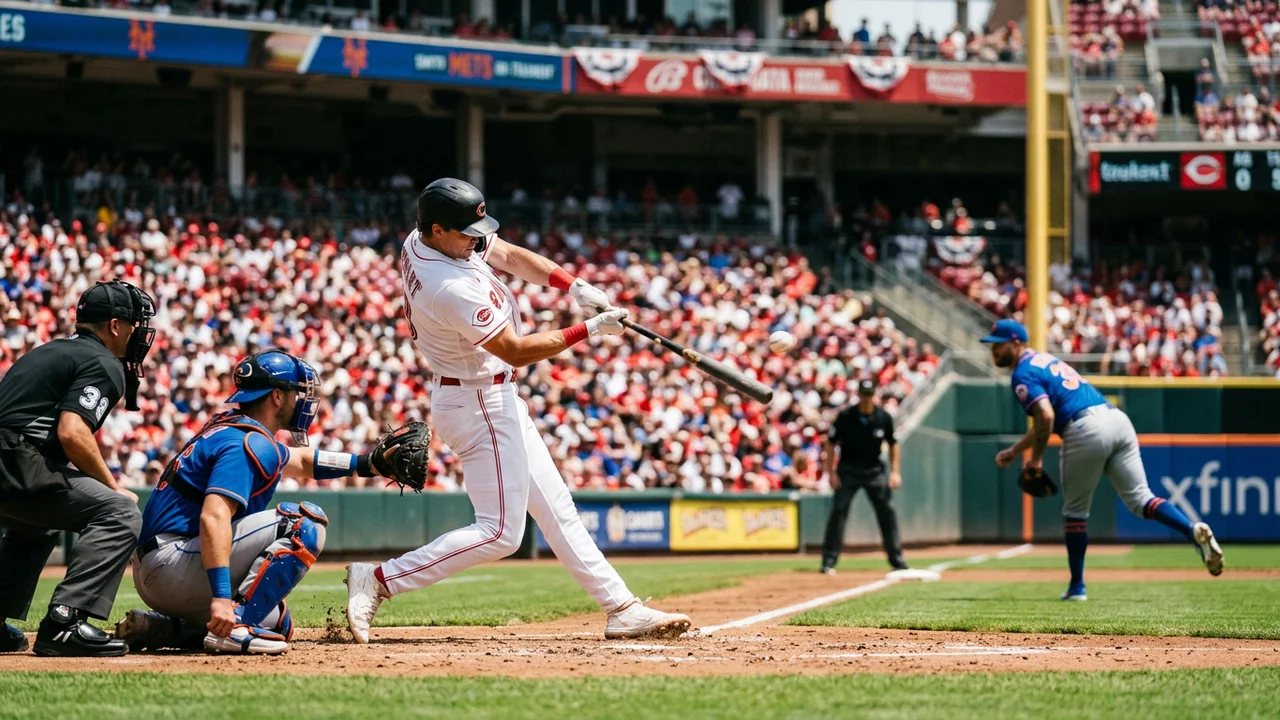
Home runs and RBIs give Stewart a clear edge in the categories that catch voters’ eyes. He’s also outpaced Mets outfielder Carson Benge, his chief statistical challenger, in doubles, 24 to 17. Stewart’s OPS sits 43 points higher than Benge’s, a testament to his extra-base power and knack for driving in runs.
But Stewart isn’t just a first baseman riding his power numbers. He’s swiped 12 bases in 16 attempts, an impressive rate for a player with below-average sprint speed. That speaks to smart, selective baserunning rather than raw athleticism. Stewart’s versatility adds another layer: while first base is his main position, he’s logged significant time at third and even a handful of games at second, all with solid defensive metrics.
That flexibility gives the Reds more options and keeps Stewart’s bat in the lineup. His season can’t be reduced to 27 homers and 98 RBIs. The stolen-base efficiency and multi-position usage complicate any attempt to pigeonhole his value.
Benge’s all-around metrics make the comparison tighter
Carson Benge doesn’t match Stewart’s home run total, but the Mets rookie has built a case that grows stronger when the conversation moves beyond traditional stats. Their triple-slash lines are similar, yet Benge holds the edge in stolen bases and triples. He’s a better runner, bringing value that RBIs can’t capture.
wRC+, the park-adjusted metric that doesn’t weigh slugging as heavily as OPS, gives Benge a one-point advantage, despite Stewart’s 43-point OPS lead. Factor in Benge’s superior baserunning, and the gap in overall offensive value widens, according to FanGraphs, Baseball Reference, and Baseball Savant.
Stewart’s advantage is in accumulation: more homers, doubles, and RBIs, with his RBI lead stretching across the entire major leagues. But advanced-value sources see Benge as the more productive offensive player, thanks to his running and park-adjusted output, dimensions Stewart’s headline stats don’t fully capture.
Benge’s defense adds another wrinkle. His average arm strength is tied for fifth among outfielders, and last week he unleashed a 103.9 mph throw, the hardest by any player all season. He ranks among league leaders in outfield assists, Statcast throwing runs, and the arm component of Defensive Runs Saved. That defensive impact gives Benge’s Rookie of the Year candidacy a dimension Stewart’s power-first résumé can’t match.